
By: Gabriela Yareliz
We got an unseasonably warm and sunny day at Fonthill Castle, Henry Mercer’s home and tile empire headquarters. The sun was dancing with the daffodils and revealing to us the clear nature of the stream below the castle terrace.
Who is Henry Chapman Mercer? That is a good question (I had no idea before). He is described as an “archeologist, artifact collector, tile-maker, and designer of three distinctive poured concrete structures: Fonthill, his home; the Moravian Pottery and Tile Works; and the Mercer Museum.” (Source) The Doylestown native was also an attorney. He came into his wealth through a wealthy aunt who set him up. I found his multi-hyphenate nature so fascinating. As I have mentioned before, the people who I find the most interesting are the ones who seem to have lived 40 lives in one. He is definitely someone who falls into that category.
What can I share about Mr. Mercer? He liked writing. People didn’t love his stories, but he didn’t care. (Loves it!) The welcome center has his book on display despite the fact that the tour guide called his stories “mediocre at best.” Personally, I would totally do that. Build my own museum and house and sell my own book. Ha. Brilliant.

He had an interesting obsession with concrete. I loved his concrete desks and book shelves. The man loved a good book. He had many volumes on Criminal Trials in Scotland (intriguing), religious books (naturally), many Walt Whitman poetry books and other volumes on poetry (he is obviously sensitive and artistic), and volumes in a series called Naval Disasters (which I found most intriguing– where can I find these?).
He cataloged his tiles and belongings, writing numbers on them. He hung stuff wherever it pleased him. The shape of his archways, stairwells and windows were imperfect, but I appreciated his slap-it-on-there-with-intention-and-make-it-cute attitude. He placed tubs under skylights (I approve), and he destroyed some of his personal belongings while keeping others (a man of mystery! He did leave his diaries to the museum– I saw a librarian from the museum confirm this. I won’t tell you what rabbit hole I went down to discover that). He was a curious man. He liked inappropriate cartoons and also was obsessed with the part in the gospels of Jesus meeting the disciples at Emmaus (he had many different depictions of this walk with Jesus throughout his home, and it was this specific scene only).
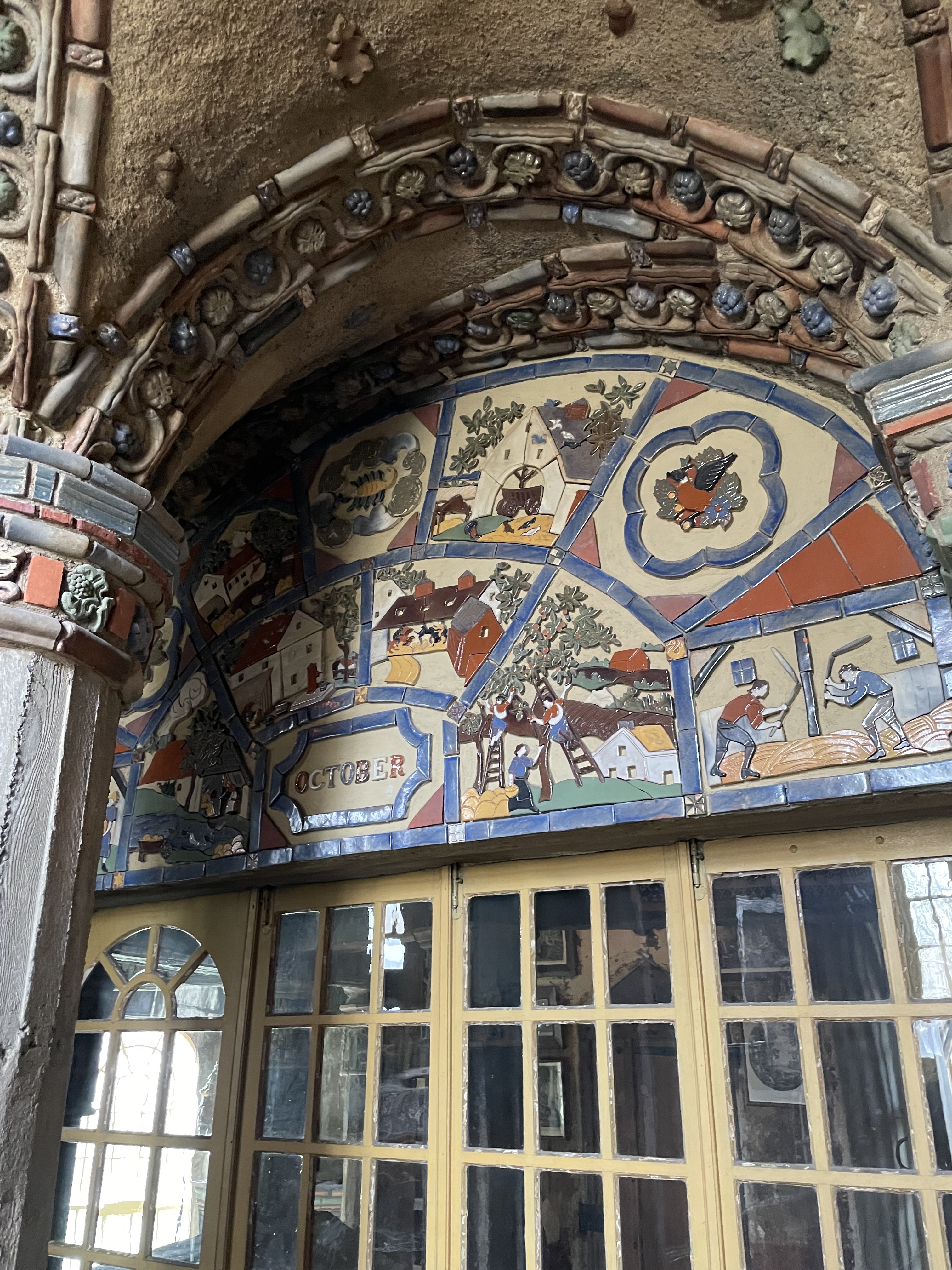
The man is most known for his tiles. He made tiles depicting “Bible, folk tales, Dickens’s Pickwick Papers, and Wagner operas” (source). They had a curious quote of his featured at the tile atelier where he said that if tiles couldn’t educate others he wouldn’t be making them. One thing I found interesting was that I don’t think tiles educate others. If you look at a story depicted and don’t have the context or knowledge of it beforehand, the picture means nothing to you. I think it is actually the inverse– only the educated can actually appreciate the detail and art in his tiles. Otherwise, it goes over your head. It’s like watching Frasier. We are a dumber society than we were before– many of the meanings in the tiles would be lost on most today. (Sadly!) We saw the biggest spider in the tile atelier! But I digress…
Just recently (today, literally, today), I completed Michael Easter’s ClearSpace app 2% challenge, where you limit screen time. Yep. Even on apps like Zillow. Who knew I opened Zillow so much? (It is a crushed-Millennial-dream haven and addiction. Looking on Zillow is like seeking the approval of a parent who hates you). The app gives you quotes and prompts to breathe or journal (I kid you not) as you try to open certain apps (and it times you). I heard about Michael Easter on a podcast (TSC Podcast: Michael Easter On How To Form Good Habits, Rewire Cravings, & Benefit From Discomfort In Your Life). I found him interesting. In the podcast and in his newsletter, he talked about how we have lost a sense of “boredom” and tolerance for discomfort, and it was this same boredom and discomfort that led people to be so intelligent and creative in the past.
How high is your boredom tolerance?
Every time I went to open Zillow, I kept thinking I could be reading Naval Disasters right now or memorizing a poem by Whitman. I think to enter the category of fascinating and intelligent, you have to be a person who embraces boredom, discomfort and slow, even in our current society. There is no escaping it. It is part of the equation. I think Mercer did it brilliantly. Not all of us have the rich aunt (or volumes of Naval Disasters), but what we do have is time and focus. We have a mind we can train. A discipline we can cultivate.
What we choose to do with that time, focus, mind and discipline is everything. When was the last time you took time to stop or engage with wonder?
“Wonder is the very engine of life.”
Erling Kagge
I am off. Off to draw or read a Mercer short story or just to look out the window and embrace the first sunshine of the week, here in NYC. Let’s be real, I will probably be searching Amazon for a volume of Naval Disasters or cataloging my most prized possessions (like Eddie). I encourage you to do the same.
“A radical new body of evidence shows that people are at their best– physically harder, mentally tougher, and spiritually sounder– after experiencing the same discomfort our early ancestors were exposed to every day.”
Michael Easter


hi Gabriela, taking care of the house museums its quite delicate. About this kind of museums , there is one, at Lyon, with the fabrics of the French Royal archive. Many designers ask permission to copy some patters from here. Also the Silk museum at Como, with the best prints of the luxury brands.