Wisteria

Image via Viator

By: Gabriela Yareliz

My husband has a green thumb. He is currently planting seeds into trays. I just pop up by the table to sniff the soil (I like the smell of soil), and then, disappear. He plants. I read about plants.

I recently read about Wisteria. Apparently, the meaner you are to Wisteria, the more it thrives. I swear. I even read Martha Stewart tapped the branches with a hammer, and it bloomed like crazy. A freakin’ masochistic plant. Or so I thought. Actually, though, it’s resilient.

“In folklore, the Wisteria’s botanical fortitude symbolizes growth, prosperity, and victory over hardship… The Wisteria’s ability to thrive in harsh conditions is a lesson in resilience,” Richard Christiansen wrote.

Have you ever been thrown into what Richard Christiansen calls “bad soil”?

Happens to me all the time. Especially, career-wise. Like Lord, give your girl a break. (We pray for a nontoxic environment, always.)

But as I read about Wisteria, I decided this was my spirit-plant (I am aware this is not an expression, but now, it is because I used it. Sort of like spirit animal— listen, I will make this a thing). I get planted in some weird places. I get my branches hammered, I am thrown into a hostile soil, and then, I bloom and thrive in my corner. It’s a vibe. I can relate. The meaner you are to me, I adapt and still push toward the sun. Try killing Wisteria, and it will grow and spread. Ha.

Wisteria. A new plant-spiration. So, when you get thrown into bad soil, a weird corner or someone takes a hammer to your branches— embody the Wisterian way.

“So work like Wisteria, even if the conditions don’t seem right. Through adversity, beauty blooms— and it keeps on blooming.” Richard Christiansen

Luck

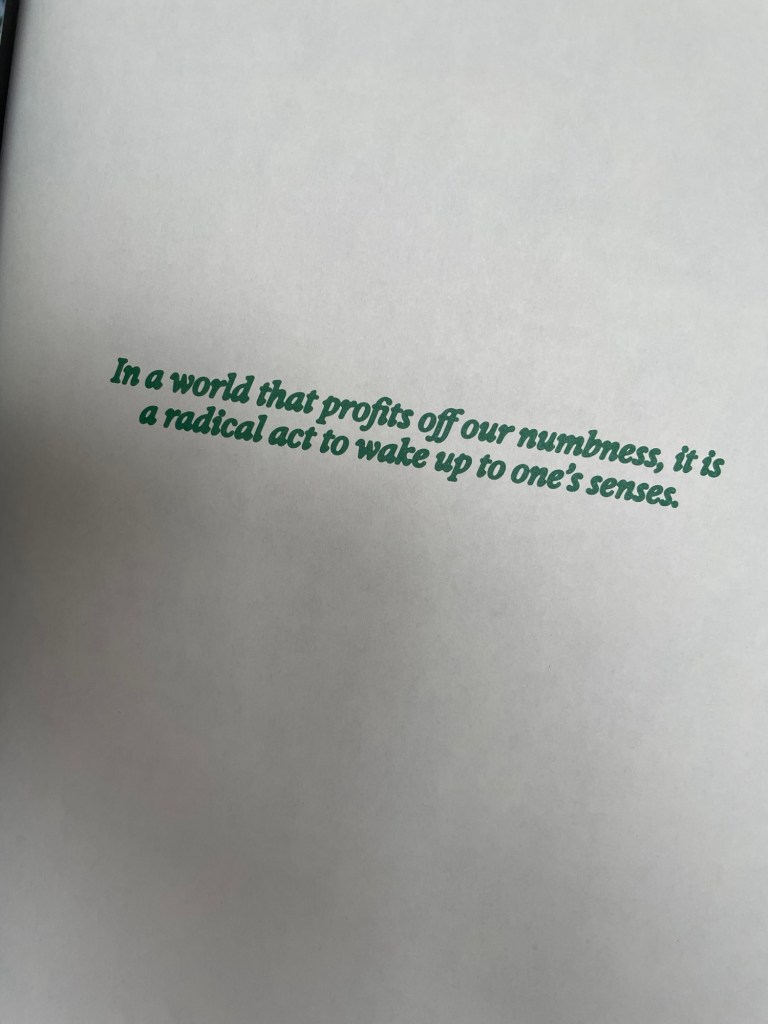
A page from The Guide to Becoming Alive

“Yes. I always tap into a Jim Collins-ism— and you know how obsessed I am with Jim Collins, who wrote Good to Great. He talked about return on luck. It’s not the luck you get, and it’s not about what actually happens. It’s how you use your luck, how you leverage it. So, it’s not what happens to you but what you do with it that differentiates you from everyone else.” Jo Horgan in conversation with Richard Christiansen

Richard: “Good luck, bad luck— is it the same?”

Jo: “It doesn’t matter. What matters is what you do next.

The Things We Can Do

By: Gabriela Yareliz

I have been reflecting on this quote lately. Hmmm.

To hold our tongues when everyone is gossiping, to smile without hostility at people and institutions, to compensate for the shortage of love in the world with more love in small, private matters; to be more faithful in our work, to show greater patience, to forgo the cheap revenge obtainable from mockery and criticism: all these are things we can do.” Hermann Hesseon

Planting Your Garden

“So plant your own gardens and decorate your own soul, instead of waiting for someone to bring you flowers.” Jorge Luis Borges

By: Gabriela Yareliz

I heard recently that when people dislike you, it serves as a reminder that if everyone liked you, you would be more reliant on the opinions of others.

It’s a human tendency to want to control and belong. We think we find safety in that. In fact, many biological propensities and desires stem from the need for belonging.

I recently read The Let Them Theory and have yet to internalize it on some days. If you haven’t read it yet, The Chalkboard Mag released a great piece called:

5 Things We Learned From The Let Them Theory By Mel Robbins—And Why It’ll Change Your Life

5 Things We Learned from The Let Them Theory by Mel Robbins—And Why It’ll Change Your Life

Leaving it here for you, in case you need a reminder.

In short— “Let people behave however they’re going to behave, and instead of taking it personally or trying to control the outcome, focus on yourself.”

Plant your own gardens! Decorate your own soul.

The Feminine

“In the ’70s, my mother gave me a print that read: A woman needs a man like a fish needs a bicycle. After 25 years of marriage, I couldn’t disagree more.” Larissa Phillips

By: Gabriela Yareliz

I read Larissa Phillips’ The Free Press piece with intrigue, as I am sure many of us did.

If you look around at the biological confusion/disassociation around us (we’ll call it that), after much study, arrows seem to point to attachment and safety in childhood. If we remove religious interpretations and look purely at biological elements as the factors— we see a giant wound with the masculine that has left a crater in the world and society. Add the complexity that women carry the emotions and traumatic experiences of their lineage in their pelvis, womb and ovaries, and you’ve got a real mess.

Women’s infertility (when it is the woman; it is 50/50) and menstrual issues, often gets attributed to a lack of safety. The conditions that lead to a shut down are often originating in a deep emotional trigger.

Women’s pain and autoimmune issues often stem from the imbalance of feeling unsafe and trying to essentially become the masculine to feel safe. I heard recently from a practitioner that women’s thyroid and adrenal issues can be traced back to a woman spending herself and trying to match a man’s energy. Men have 17x more testosterone than women. Can you imagine the insanity of trying to match that as a woman? But we do it— ALL THE TIME.

We have no choice in a lot of things that affect us— whether our grandfather was unfaithful to our grandmother and how she carried that anguish, whether those in our lineage felt abandonment and lack of safety, the relationships our parents had with their parents and our grandparents with theirs. Our parents’ relationship to each other and whether they caused each other pain. Single parenthood. Men not being protectors. Our own childhood adaptations that helped us survive. What is in our control is now. What we do now. How we show up in our relationships, now.

If femininity requires safety, connection and vulnerability— how are we striving for that? How do we provide our own safety? How do we allow others to provide it to us? The ability to open a bank account, buy property and make our own money has helped us better survive the failings and wounds of the masculine— let’s be real. But what should our default be? How do we give the next generation less trauma?

When we find a worthy, good man who offers us safety and connection, how do we begin dropping the pieces of armor and heal the wounds that have led us to try to live beyond our biological means?

How do we begin forgiving others and ourselves for all we did not know?

None of those have easy answers, but seeking those answers is necessary. As a society, we are out of alignment. If we look around us, we see wounding everywhere. Healing just can’t be optional.

Every day, we begin again. Every day is a gift. Every day, we can adjust the compass a bit more so we can arrive to the true destination. So we can arrive whole and light.

I heard a message recently that highlighted that one of the only places we see the word “easy” in Scripture is when Jesus invites us to trade in our baggage for His yoke.

“Come to me, all you who are weary and burdened, and I will give you rest. Take my yoke upon you and learn from me, for I am gentle and humble in heart, and you will find rest for your souls. For my yoke is easy and my burden is light.” Matthew 11:28-30

His way is different. His way unburdens us. And while no journey is truly easy— taking His way offers us rest, He says.

Isn’t it interesting that the feminine is also lighter and softer— it rests in safety. It’s the softness, not pushing through, that heals us.

If we are to be healed, one of the first steps is laying down our armor and weapons. You can’t mow a lawn with a water sprinkler. Our design matters. Often, healing is found in a surrender and vulnerability. It starts with an acknowledgment of our weariness.


The Beauty of Enough

Never let the quest for more distract you from the beauty of enough.” Sahil Bloom

Image from Pinterest

By: Gabriela Yareliz

Spring invites us into simplicity. I am only 1/4 into my spring cleaning. The season’s freshness invites us to cleanse out, to simplify, to go back to the basics. A mini candle, a white t-shirt, a fresh cleaner, a duster, a trash bag, teas and herbs, an open window with rain. All essentials. It’s a time where I examine clothes and shoes and see what needs to be retired and what needs to come to the front. The old gets swept away.

If winter brings maximalism we ramp up to through the autumn, spring has us shedding layers as we tumble toward the minimalism of summer.

Shedding reminds us it’s less about more, and it’s more about enough. There is beauty in enough, as Bloom says. We lessen distractions, and keep it focused.

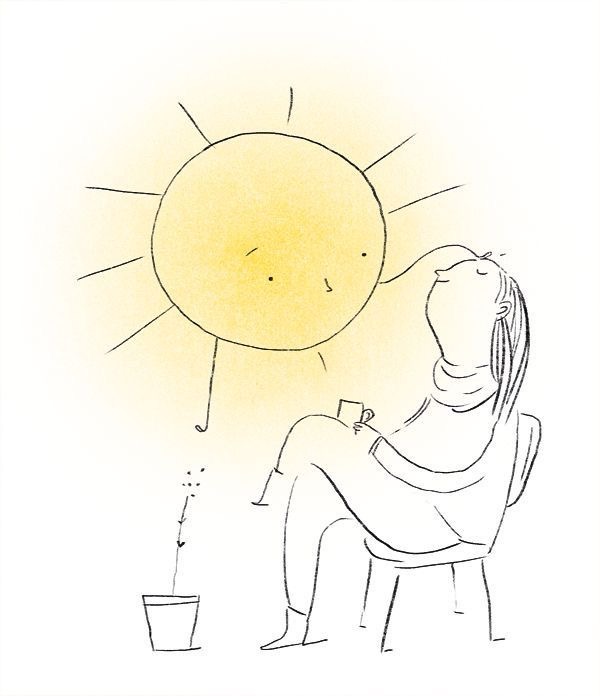
We declutter our minds and spirits. We prepare for the freedom of summer. The beauty of enough deserves its moment in the sun. We don’t need more. The freedom of enough is brighter.

Presence

By: Gabriela Yareliz

I love when Mosaic is in NYC for worship. Every time I leave the gathering, I know I have been in God’s presence.

Here is a rule of thumb for life always— when given the option to be in God’s presence, whether a church gathering or at home with your Bible, never turn it down. Never postpone or replace time in God’s presence. You will never regret choosing it.